 Add to Chrome
 Add to Firefox
 Add to Edge
Hand-in-the-Loop: Improving Dexterous VLA via Seamless Interventional Correction
May 14, 2026
Vision-Language-Action (VLA) models are prone to compounding errors in dexterous manipulation, where high-dimensional action spaces and contact-rich dynamics amplify small policy deviations over long horizons. While Interactive Imitation Learning (IIL) can refine policies through human takeover data, applying it to high-degree-of-freedom (DoF) robotic hands remains challenging due to a command mismatch between human teleoperation and policy execution at the takeover moment, which causes abrupt robot-hand configuration changes, or "gesture jumps". We present Hand-in-the-Loop (HandITL), a seamless human-in-the-loop intervention method that blends human corrective intent with autonomous policy execution to avoid gesture jumps during bimanual dexterous manipulation. Compared with direct teleoperation takeover, HandITL reduces takeover jitter by 99.8% and preserves robust post-takeover manipulation, reducing grasp failures by 87.5% and mean completion time by 19.1%. We validate HandITL on tasks requiring bimanual coordination, tool use, and fine-grained long-horizon manipulation. When used to collect intervention data for policy refinement, HandITL yields policies that outperform those trained with standard teleoperation data by 19% on average across three long-horizon dexterous tasks.

Structured prototype regularization for synthetic-to-real driving scene parsing
Mar 17, 2026Driving scene parsing is critical for autonomous vehicles to operate reliably in complex real-world traffic environments. To reduce the reliance on costly pixel-level annotations, synthetic datasets with automatically generated labels have become a popular alternative. However, models trained on synthetic data often perform poorly when applied to real-world scenes due to the synthetic-to-real domain gap. Despite the success of unsupervised domain adaptation in narrowing this gap, most existing methods mainly focus on global feature alignment while overlooking the semantic structure of the feature space. As a result, semantic relations among classes are insufficiently modeled, limiting the model's ability to generalize. To address these challenges, this study introduces a novel unsupervised domain adaptation framework that explicitly regularizes semantic feature structures to significantly enhance driving scene parsing performance in real-world scenarios. Specifically, the proposed method enforces inter-class separation and intra-class compactness by leveraging class-specific prototypes, thereby enhancing the discriminability and structural coherence of feature clusters. An entropy-based noise filtering strategy improves the reliability of pseudo labels, while a pixel-level attention mechanism further refines feature alignment. Extensive experiments on representative benchmarks demonstrate that the proposed method consistently outperforms recent state-of-the-art methods. These results underscore the importance of preserving semantic structure for robust synthetic-to-real adaptation in driving scene parsing tasks.
PersonaTrace: Synthesizing Realistic Digital Footprints with LLM Agents
Mar 12, 2026Digital footprints (records of individuals' interactions with digital systems) are essential for studying behavior, developing personalized applications, and training machine learning models. However, research in this area is often hindered by the scarcity of diverse and accessible data. To address this limitation, we propose a novel method for synthesizing realistic digital footprints using large language model (LLM) agents. Starting from a structured user profile, our approach generates diverse and plausible sequences of user events, ultimately producing corresponding digital artifacts such as emails, messages, calendar entries, reminders, etc. Intrinsic evaluation results demonstrate that the generated dataset is more diverse and realistic than existing baselines. Moreover, models fine-tuned on our synthetic data outperform those trained on other synthetic datasets when evaluated on real-world out-of-distribution tasks.
FLAC: Maximum Entropy RL via Kinetic Energy Regularized Bridge Matching
Feb 13, 2026Iterative generative policies, such as diffusion models and flow matching, offer superior expressivity for continuous control but complicate Maximum Entropy Reinforcement Learning because their action log-densities are not directly accessible. To address this, we propose Field Least-Energy Actor-Critic (FLAC), a likelihood-free framework that regulates policy stochasticity by penalizing the kinetic energy of the velocity field. Our key insight is to formulate policy optimization as a Generalized Schrödinger Bridge (GSB) problem relative to a high-entropy reference process (e.g., uniform). Under this view, the maximum-entropy principle emerges naturally as staying close to a high-entropy reference while optimizing return, without requiring explicit action densities. In this framework, kinetic energy serves as a physically grounded proxy for divergence from the reference: minimizing path-space energy bounds the deviation of the induced terminal action distribution. Building on this view, we derive an energy-regularized policy iteration scheme and a practical off-policy algorithm that automatically tunes the kinetic energy via a Lagrangian dual mechanism. Empirically, FLAC achieves superior or comparable performance on high-dimensional benchmarks relative to strong baselines, while avoiding explicit density estimation.
ShotFinder: Imagination-Driven Open-Domain Video Shot Retrieval via Web Search
Jan 30, 2026In recent years, large language models (LLMs) have made rapid progress in information retrieval, yet existing research has mainly focused on text or static multimodal settings. Open-domain video shot retrieval, which involves richer temporal structure and more complex semantics, still lacks systematic benchmarks and analysis. To fill this gap, we introduce ShotFinder, a benchmark that formalizes editing requirements as keyframe-oriented shot descriptions and introduces five types of controllable single-factor constraints: Temporal order, Color, Visual style, Audio, and Resolution. We curate 1,210 high-quality samples from YouTube across 20 thematic categories, using large models for generation with human verification. Based on the benchmark, we propose ShotFinder, a text-driven three-stage retrieval and localization pipeline: (1) query expansion via video imagination, (2) candidate video retrieval with a search engine, and (3) description-guided temporal localization. Experiments on multiple closed-source and open-source models reveal a significant gap to human performance, with clear imbalance across constraints: temporal localization is relatively tractable, while color and visual style remain major challenges. These results reveal that open-domain video shot retrieval is still a critical capability that multimodal large models have yet to overcome.
RePose: A Real-Time 3D Human Pose Estimation and Biomechanical Analysis Framework for Rehabilitation
Jan 02, 2026We propose a real-time 3D human pose estimation and motion analysis method termed RePose for rehabilitation training. It is capable of real-time monitoring and evaluation of patients'motion during rehabilitation, providing immediate feedback and guidance to assist patients in executing rehabilitation exercises correctly. Firstly, we introduce a unified pipeline for end-to-end real-time human pose estimation and motion analysis using RGB video input from multiple cameras which can be applied to the field of rehabilitation training. The pipeline can help to monitor and correct patients'actions, thus aiding them in regaining muscle strength and motor functions. Secondly, we propose a fast tracking method for medical rehabilitation scenarios with multiple-person interference, which requires less than 1ms for tracking for a single frame. Additionally, we modify SmoothNet for real-time posture estimation, effectively reducing pose estimation errors and restoring the patient's true motion state, making it visually smoother. Finally, we use Unity platform for real-time monitoring and evaluation of patients' motion during rehabilitation, and to display the muscle stress conditions to assist patients with their rehabilitation training.
GR-Dexter Technical Report
Dec 30, 2025Vision-language-action (VLA) models have enabled language-conditioned, long-horizon robot manipulation, but most existing systems are limited to grippers. Scaling VLA policies to bimanual robots with high degree-of-freedom (DoF) dexterous hands remains challenging due to the expanded action space, frequent hand-object occlusions, and the cost of collecting real-robot data. We present GR-Dexter, a holistic hardware-model-data framework for VLA-based generalist manipulation on a bimanual dexterous-hand robot. Our approach combines the design of a compact 21-DoF robotic hand, an intuitive bimanual teleoperation system for real-robot data collection, and a training recipe that leverages teleoperated robot trajectories together with large-scale vision-language and carefully curated cross-embodiment datasets. Across real-world evaluations spanning long-horizon everyday manipulation and generalizable pick-and-place, GR-Dexter achieves strong in-domain performance and improved robustness to unseen objects and unseen instructions. We hope GR-Dexter serves as a practical step toward generalist dexterous-hand robotic manipulation.
Diffusion priors enhanced velocity model building from time-lag images using a neural operator
Dec 29, 2025Velocity model building serves as a crucial component for achieving high precision subsurface imaging. However, conventional velocity model building methods are often computationally expensive and time consuming. In recent years, with the rapid advancement of deep learning, particularly the success of generative models and neural operators, deep learning based approaches that integrate data and their statistics have attracted increasing attention in addressing the limitations of traditional methods. In this study, we propose a novel framework that combines generative models with neural operators to obtain high resolution velocity models efficiently. Within this workflow, the neural operator functions as a forward mapping operator to rapidly generate time lag reverse time migration (RTM) extended images from the true and migration velocity models. In this framework, the neural operator is acting as a surrogate for modeling followed by migration, which uses the true and migration velocities, respectively. The trained neural operator is then employed, through automatic differentiation, to gradually update the migration velocity placed in the true velocity input channel with high resolution components so that the output of the network matches the time lag images of observed data obtained using the migration velocity. By embedding a generative model, trained on a high-resolution velocity model distribution, which corresponds to the true velocity model distribution used to train the neural operator, as a regularizer, the resulting predictions are cleaner with higher resolution information. Both synthetic and field data experiments demonstrate the effectiveness of the proposed generative neural operator based velocity model building approach.
WMPO: World Model-based Policy Optimization for Vision-Language-Action Models
Nov 12, 2025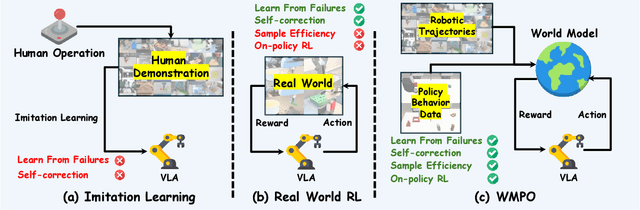
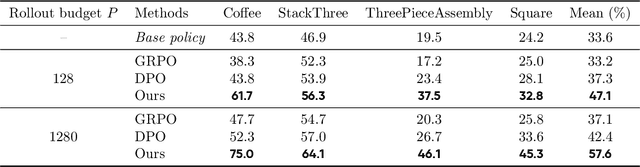
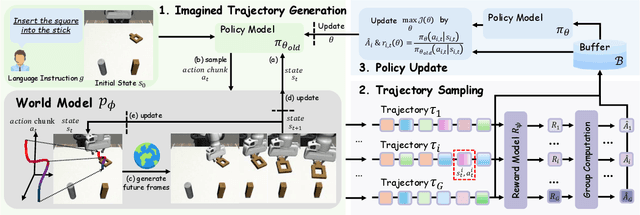
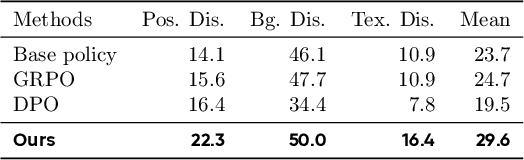
Vision-Language-Action (VLA) models have shown strong potential for general-purpose robotic manipulation, but their reliance on expert demonstrations limits their ability to learn from failures and perform self-corrections. Reinforcement learning (RL) addresses these through self-improving interactions with the physical environment, but suffers from high sample complexity on real robots. We introduce World-Model-based Policy Optimization (WMPO), a principled framework for on-policy VLA RL without interacting with the real environment. In contrast to widely used latent world models, WMPO focuses on pixel-based predictions that align the "imagined" trajectories with the VLA features pretrained with web-scale images. Crucially, WMPO enables the policy to perform on-policy GRPO that provides stronger performance than the often-used off-policy methods. Extensive experiments in both simulation and real-robot settings demonstrate that WMPO (i) substantially improves sample efficiency, (ii) achieves stronger overall performance, (iii) exhibits emergent behaviors such as self-correction, and (iv) demonstrates robust generalization and lifelong learning capabilities.
An effective physics-informed neural operator framework for predicting wavefields
Jul 22, 2025Solving the wave equation is fundamental for geophysical applications. However, numerical solutions of the Helmholtz equation face significant computational and memory challenges. Therefore, we introduce a physics-informed convolutional neural operator (PICNO) to solve the Helmholtz equation efficiently. The PICNO takes both the background wavefield corresponding to a homogeneous medium and the velocity model as input function space, generating the scattered wavefield as the output function space. Our workflow integrates PDE constraints directly into the training process, enabling the neural operator to not only fit the available data but also capture the underlying physics governing wave phenomena. PICNO allows for high-resolution reasonably accurate predictions even with limited training samples, and it demonstrates significant improvements over a purely data-driven convolutional neural operator (CNO), particularly in predicting high-frequency wavefields. These features and improvements are important for waveform inversion down the road.